headerphoto

We will use three unit of BSH 222 switch for control a motor glue pump. The glue must distribute to three different location, such us Line1, Line2 and Line3. Each switch store in each Line location.
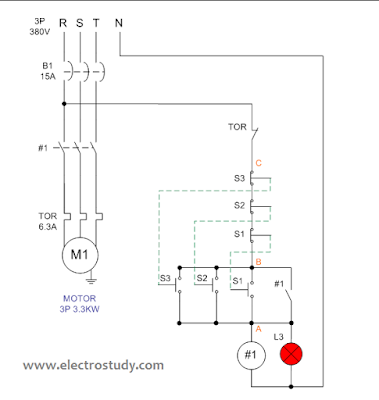
Wiring diagram 3 phase motor 3.3 kW with three unit of BSH 222 switch

wiring_motor_3_phase_3.3kw_with_3_switch_bsh_222

Electric parts needed for the wiring 3 Phase motor 3.3 kW with three unit of BSH 222 switch above:

  • B1 = MCB 15A 3 phase
  • M1 = Motor 3.3kW 380V 3Phase
  • #1 = Magnetic contactor 220VAC
  • TOR = Thermal overload relay 6.3A
  • S1, S2, S3 = Push button switch type BSH 222
  • L3 = Pilot lamp 220VAC

Wiring connection of BSH 222 switch

switch_bsh_222_connection

BHS 222 switch has an two contacts switch, NO (Normally Open for ON button) Contact and NC (Normally Close for OFF button) contact. In wiring 3 Phase motor 3.3 kW with three unit of BSH 222 switch, we use to series connection the NC contact and to parallel connection the NO contact.

Read more »»

BSH 222 is a Type of Push Button Switch

Kasuga BSH 222 is a type of push button switch, which has an ON button and an OFF button in one switch. ON button BSH 222 marked with black color, position above OFF button. OFF button BSH 222 marked with red color, position below ON button.

BSH 222

PTM and PTB

ON button in a BSH 222 switch is type of PTM (push to make) non latching. OFF button in a BSH 222 switch is type of PTB (push to brake) non latching. Picture below is a symbol of BHS 222 switch.


Contact Capacity

Electric voltage and current capacity of the contact point BSH 222:
250 V max 5 A
500 V max 1 A.

Purpose

BSH 222 switch usually used for control (start and stop) small electric motor. For some case, one motor is controlled by many BSH 222 switch. One unit BSH 222 and other unit of them, are placed in different location, use for control a motor, such us motor glue pump who will distribute the glue for each location.

Read more »»

In most industrial system control machine, there's a start switch and there' re a lot of stop switch. Start switch location is on the panel operator. Stop switches location are on the control box, in each unit of the machine. Stop switch connection in wiring diagram are series connections.

Wiring diagram 3 Phase motor 2.2 kW with stop series connection


Electric parts needed for the wiring 3 phase motor 2.2 kW above::
  1. B1 = MCB 10A 3 phase
  2. M1 = Motor 2.2kW 380V 3Phase
  3. #1 = Magnetic contactor 220VAC
  4. TOR = Thermal Overload Relay 4.2A
  5. S1, S2, S3 = Push Button Switch (PTB non latching - stop switch)
  6. S4 = Push Button Switch (PTM non latching - start switch)
  7. L3 = Pilot lamp 220VAC

Read more »»

Basic control motor, to get start or stop the motor, use a push button switch as a trigger a motor. Push To Make / PTM switch use to start the motor and Push To Brake / PTB switch use to stop the motor.

Wiring diagram single motor with Start - Stop switch


Electric parts needed for the wiring above:
  1. B1 = MCB 5A 3 phase
  2. M1 = Motor 1.5kW 380V 3Phase
  3. #1 = Magnetic contactor 220VAC
  4. TOR = Thermal Overload Relay 2.8A
  5. S1 = Push Button Switch (PTB non latching - Stop switch)
  6. S2 = Push Button Switch (PTM non latching - Start switch)
  7. L3 = Pilot lamp 220VAC

Read more »»

Basic control motor, to get start or stop the motor, only use a selector switch as a trigger a motor.

Wiring diagram single motor with selector switch

Electric parts needed for the wiring above:
  1. B1 = MCB 5A 3 phase
  2. M1 = Motor 0.75kW 380V 3Phase
  3. #1 = Magnetic contactor 220VAC
  4. TOR = Thermal Overload Relay 1.4A
  5. S1 = Selector Switch
  6. L3 = Pilot lamp 220VAC

Read more »»

Hexadecimal number system is numeral system with a base of 16. Represents numeric values using sixteen symbols, 0, 1, 2, 3, 4, 5, 6, 7, 8, 9, A, B, C, D, E and F.

Table below is hexadecimal number from 1 to 64, equivalent of 1 to 100 in decimal number.
HexadecimalDecimalHexadecimalDecimal
113351
223452
333553
443654
553755
663856
773957
883A58
993B59
A103C60
B113D61
C123E62
D133F63
E144064
F154165
10164266
11174367
12184468
13194569
14204670
15214771
16224872
17234973
18244A74
19254B75
1A264C76
1B274D77
1C284E78
1D294F79
1E305080
1F315181
20325282
21335383
22345484
23355585
24365686
25375787
26385888
27395989
28405A90
29415B91
2A425C92
2B435D93
2C445E94
2D455F95
2E466096
2F476197
30486298
31496399
325064100

Read more »»

Octal number system is numeral system with a base of 8. Represents numeric values using eight symbols, 0, 1, 2, 3, 4, 5, 6 and 7. There is no 8 or 9 in octal number system.

Table below is octal number from 1 to 144, equivalent of 1 to 100 in decimal number.
OctalDecimalOctalDecimal
116351
226452
336553
446654
556755
667056
777157
1087258
1197359
12107460
13117561
14127662
15137763
161410064
171510165
201610266
211710367
221810468
231910569
242010670
252110771
262211072
272311173
302411274
312511375
322611476
332711577
342811678
352911779
363012080
373112181
403212282
413312383
423412484
433512585
443612686
453712787
463813088
473913189
504013290
514113391
524213492
534313593
544413694
554513795
564614096
574714197
604814298
614914399
6250144100

Read more »»

Binary number system is numeral system with a base of 2. Represents numeric values using two symbols, 0 and 1. There is no 2,3,4,5,6,7,8 or 9 in binary number system.

Table below is binary number from 1 to 1100100, equivalent of 1 to 100 in decimal number.
Binary DecimalBinaryDecimal
1111001151
10211010052
11311010153
100411011054
101511011155
110611100056
111711100157
1000811101058
1001911101159
10101011110060
10111111110161
11001211111062
11011311111163
111014100000064
111115100000165
1000016100001066
1000117100001167
1001018100010068
1001119100010169
1010020100011070
1010121100011171
1011022100100072
1011123100100173
1100024100101074
1100125100101175
1101026100110076
1101127100110177
1110028100111078
1110129100111179
1111030101000080
1111131101000181
10000032101001082
10000133101001183
10001034101010084
10001135101010185
10010036101011086
10010137101011187
10011038101100088
10011139101100189
10100040101101090
10100141101101191
10101042101110092
10101143101110193
10110044101111094
10110145101111195
10111046110000096
10111147110000197
11000048110001098
11000149110001199
110010501100100100

Read more »»

Convert hexadecimal numbers to octal numbers
1. F4
2. ADE
3. 8C1F

Completion:
1. F4 (16) = ? (8)
* First, convert hexadecimal numbers to decimal numbers. Then, convert decimal numbers to octal numbers.

hexadecimal to decimal
F4 = 4x160 + Fx161
F4 = 4x160 + 15x161
F4 = 4 + 240
F4 (16) = 244 (10)

decimal to octal
244 / 8 = 30, remains 4
30 / 8 = 3, remains 6
3 / 8 = 0, remains 3
244 (10) = 364 (8)

F4 hexadecimal number equal to 364 octal number
F4 (16) = 364 (8)

2. ADE (16) = ? (8)
hexadecimal to decimal
ADE = Ex160 + Dx161 + Ax162
ADE = 14x160 + 13x161 + 10x162
ADE = 14 + 208 + 2560
ADE (16) = 2782 (10)

decimal to octal
2782 / 8 = 347, remains 6
347 / 8 = 43, remains 3
43 / 8 = 5, remains 3
5 / 8 = 0, remains 5
3501 (10) = 5336 (8)

ADE hexadecimal number equal to 5336 octal number
ADE (16) = 5336 (8)

3. 8C1F (16) = ? (8)
hexadecimal to decimal
8C1F = Fx160 + 1x161 + Cx162 + 8x163
8C1F = 15x160 + 1x161 + 12x162 + 8x163
8C1F = 15 + 16 + 3072 + 32768
8C1F (16) = 35871 (10)

decimal to octal
35871 / 8 = 4483, remains 7
4483 / 8 = 560, remains 3
560 / 8 = 70, remains 0
70 / 8 = 8, remains 6
8 / 8 = 1, remains 0
1 / 8 = 0, remains 1
605025 (10) = 106037 (8)

8C1F hexadecimal number equal to 106037 octal number
8C1F (16) = 106037 (8)

Read more »»

Convert hexadecimal numbers to binary numbers
1. 2B
2. DAD
3. FE01

Completion:
1. 2B (16) = ? (2)
* First, convert hexadecimal numbers to decimal numbers. Then, convert decimal numbers to binary numbers.

hexadecimal to decimal
2B = Bx160 + 2x161
2B = 11x160 + 2x161
2B = 11 + 32
2B (16) = 43 (10)

decimal to binary
43 / 2 = 21, remains 1
21 / 2 = 10, remains 1
10 / 2 = 5, remains 0
5 / 2 = 2, remains 1
2 / 2 = 1, remains 0
1 / 2 = 0, remains 1
43 (10) = 101011 (2)

2B hexadecimal number equal to 101011 binary number
2B (16) = 101011 (2)

2. DAD (16) = ? (2)
hexadecimal to decimal
DAD = Dx160 + Ax161 + Ax162
DAD = 13x160 + 10x161 + 13x162
DAD = 13 + 160 + 3328
DAD (16) = 3501 (10)

decimal to binary
3501 / 2 = 1750, remains 1
1750 / 2 = 875, remains 0
875 / 2 = 437, remains 1
437 / 2 = 218, remains 1
218 / 2 = 109, remains 0
109 / 2 = 54, remains 1
54 / 2 = 27, remains 0
27 / 2 = 13, remains 1
13 / 2 = 6, remains 1
6 / 2 = 3, remains 0
3 / 2 = 1, remains 1
1 / 2 = 0, remains 1
3501 (10) = 110110101101 (2)

DAD hexadecimal number equal to 110110101101 binary number
DAD (16) = 110110101101 (2)

3. FE01 (16) = ? (2)
hexadecimal to decimal
FE01 = 1x160 + 0x161 + Ex162 + Fx163
FE01 = 1x160 + 0x161 + 14x162 + 15x163
FE01 = 1 + 0 + 3584 + 61440
FE01 (16) = 65025 (10)

decimal to binary
65025 / 2 = 32512, remains 1
32512 / 2 = 16256, remains 0
16256 / 2 = 8128, remains 0
8128 / 2 = 4064, remains 0
4064 / 2 = 2032, remains 0
2032 / 2 = 1016, remains 0
1016 / 2 = 508, remains 0
508 / 2 = 254, remains 0
254 / 2 = 127, remains 0
127 / 2 = 63, remains 1
63 / 2 = 31, remains 1
31 / 2 = 15, remains 1
15 / 2 = 7, remains 1
7 / 2 = 3, remains 1
3 / 2 = 1, remains 1
1 / 2 = 0, remains 1
605025 (10) = 1111111000000001 (2)

FE01 hexadecimal number equal to 1111111000000001 binary number
FE01 (16) = 1111111000000001 (2)

Read more »»

Next Previous